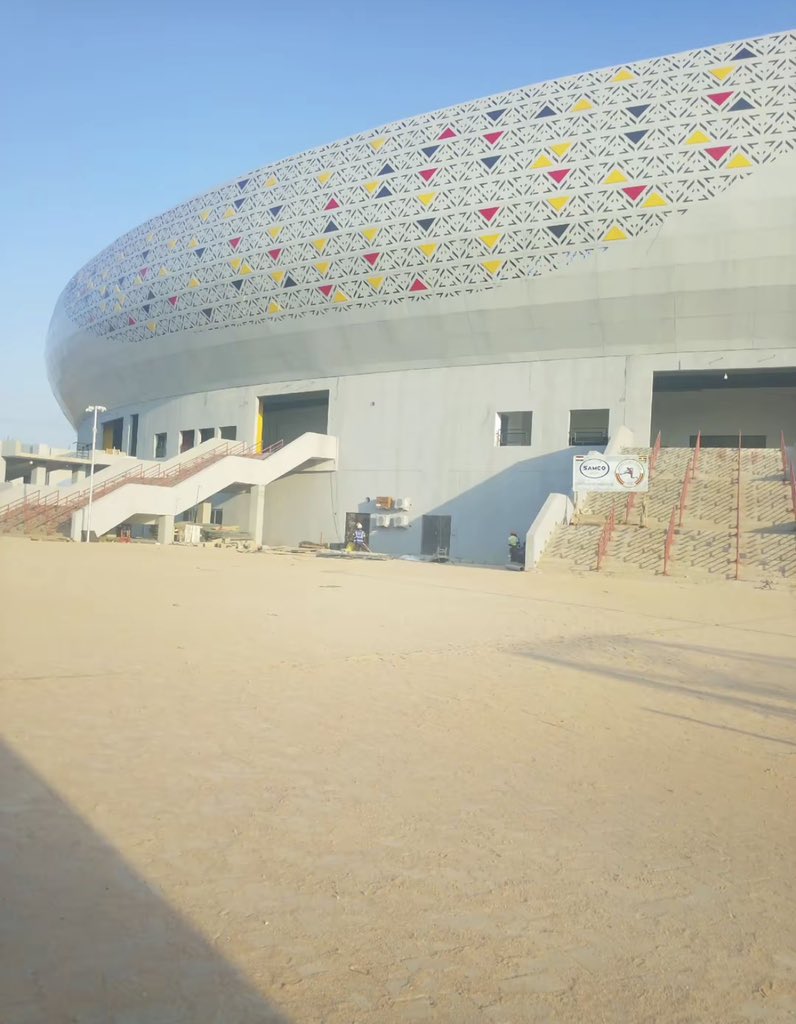
Uganda's sports landscape is beginning to take a different shape, with the construction of new stadiums and the redevelopment of existing facilities opening up opportunities for major competitions to move beyond Kampala.
At the centre of that change is Hoima City Stadium, a facility that has quickly moved from being a new construction project to becoming one of the country's emerging sporting homes.
The stadium recently witnessed another important moment when the Uganda Cranes hosted Libya in a 2027 Africa Cup of Nations qualifier. Uganda secured a 1-0 victory, with Vula's first-half stoppage-time header giving the Cranes the crucial win.
For the supporters who filled the stadium, it was an indication of what modern sports infrastructure can bring to communities outside the traditional sporting centres of Uganda.
Before the Cranes' arrival, Hoima City Stadium had already begun making its mark on continental football.
Kitara FC chose the facility as its home for its CAF Confederation Cup campaign, hosting Somalia's Mogadishu City in both legs of the preliminary round.
Kitara won both matches and progressed to the next stage, setting up a much bigger challenge against Egyptian giants Al Ahly.
For a club from western Uganda, playing continental football at a modern home stadium has given the region something that has often been missing - a major football venue capable of hosting international competition.
And for the National Council of Sports General Secretary, Dr Benard Patrick Ogwel, the growing number of supporters attending such matches is part of the bigger picture.
The crowds, according to Ogwel, demonstrate the appetite Ugandans have for sport and underline why investment in sporting facilities should not be concentrated in one part of the country.
The thinking is simple: when good facilities are available, they create the conditions for sport to growth and Hoima City Stadium is providing an early example.
The stadium is not only a football venue. It forms part of a wider sporting complex designed to accommodate different disciplines, including athletics, basketball, volleyball, netball and swimming.
That multi-purpose character is important because Uganda's sporting future cannot depend on football alone.
Akii-Bua takes the development further
The next major piece of Uganda's infrastructure puzzle is taking shape in Lira.
The Akii-Bua Olympic Stadium, named after Uganda's legendary Olympic champion John Akii-Bua, is nearing completion and is expected to provide northern Uganda with a modern facility capable of hosting national and international competitions.
For Ogwel, the development represents another step towards spreading sporting opportunities across the country.
The idea is that Uganda should have quality facilities in different regions so that athletes and sporting communities do not always have to travel to Kampala to compete or train at high-level venues.
Akii-Bua is being developed as a multi-sport facility, with the main stadium complemented by training facilities, indoor sporting spaces, swimming facilities and accommodation.
Akii-Bua's name is associated with one of the greatest moments in Uganda's Olympic history. Giving the stadium his name creates a link between the country's sporting past and the infrastructure being built for its future.
The expectation is that the facility will become a centre for athletics and other sports in northern Uganda while also providing a venue for major football matches.
Namboole gets another lease of life
While Hoima and Akii-Bua represent new investment, Mandela National Stadium, Namboole, remains central to Uganda's sporting ambitions.
The redevelopment of Namboole is aimed at giving Uganda's most established national stadium another lease of life and ensuring that it can continue hosting major international competitions.
For years, Namboole has been the country's principal stage for major football matches.
Its rehabilitation therefore goes beyond repairing a stadium. It is about restoring one of Uganda's most recognisable sporting venues to a level capable of meeting modern international standards.
The combination of Namboole's redevelopment and the construction of new regional stadiums could eventually give Uganda a much broader network of venues.
Instead of having one dominant national facility, the country could have several stadiums capable of hosting high-level competitions.
The indoor sports revolution
The infrastructure conversation is also moving beyond football stadiums.
Hoima City Stadium has an indoor arena, while the Akii-Bua project also incorporates indoor sporting facilities.
This is significant for sports such as basketball, volleyball and other indoor disciplines, which have continued to grow in popularity in Uganda.
Hoima has already demonstrated the possibilities.
The city's indoor sporting facilities have provided a venue for major domestic competition, including the National Basketball League final involving City Oilers and Namuwongo Blazers.
The Blazers ultimately took the title, but the bigger story was the ability of a newly developing sports city outside Kampala to host one of Uganda's biggest indoor sporting events.
For Ogwel, such developments are part of a broader vision in which sports facilities serve several disciplines rather than remaining empty whenever football is not being played.
Lugogo could add another dimension
Attention is also turning towards the proposed redevelopment of Lugogo Indoor Arena.
The planned facility is expected to provide modern infrastructure for indoor sports, including a swimming facility, and could become another major centre for sports in Kampala.
Lugogo has historically been an important location for Ugandan sport, and its redevelopment would add another modern venue to the country's growing network.
The challenge, however, is ensuring that the projects move from plans to functioning facilities and that completed infrastructure is properly managed.
Beyond AFCON 2027
Uganda's current stadium construction and rehabilitation drive is closely connected to the country's preparations for the 2027 Africa Cup of Nations.
But Ogwel's argument goes beyond the tournament.
The facilities being developed now are expected to remain part of Uganda's sporting infrastructure long after the last AFCON match has been played.
That becomes even more important with Uganda set to host the 2031 African Games.
The Games will require facilities for a wide range of disciplines, meaning that stadiums, indoor arenas, swimming pools, training grounds and accommodation facilities will all have a role to play.
In that sense, the current construction programme can be viewed as an investment in the country's wider sporting ecosystem rather than simply preparations for one tournament.
For Uganda's sports infrastructure ambitions to succeed, however, building the facilities will only be the beginning.
However, Modern stadiums require regular activity, professional management and sustainable revenue if they are to remain in good condition.
Clubs need to use them. Federations need to organise competitions in them. Schools and academies need access to them. Athletes need places to train.
And supporters need reasons to return and Hoima is already providing an interesting model.
Kitara FC has found a home there. The Uganda Cranes have played there. Basketball has been staged there. Other sporting disciplines can also use the complex.
That is the type of activity that can turn a stadium from a structure into a sporting ecosystem.
For decades, Uganda's biggest sporting events have been heavily concentrated in Kampala.
The emergence of Hoima City Stadium, the development of Akii-Bua Stadium and the redevelopment of Namboole point towards a different future.
Western Uganda now has a facility capable of hosting major international football.
Northern Uganda is getting a major multi-sport complex.
Kampala is retaining and upgrading its national sporting facilities.
And plans for further indoor and regional infrastructure could extend that network even further.
For Ogwel and the National Council of Sports, the ultimate objective is therefore much bigger than having impressive stadiums.
It is about creating an environment in which Ugandan sport can grow across the country.
Hoima may have provided the first strong glimpse of what that future can look like.
Akii-Bua could extend it to the north and Namboole could reinforce the national centre.
And with further investment in indoor and regional facilities, Uganda's sporting map could look very different by the time the country reaches the 2031 African Games.
The stadiums may be made of concrete, steel and seats, but their real value will ultimately be measured by what happens inside them the athletes they develop, the clubs they support, the competitions they host and the sporting culture they create across Uganda.
Hoima City Stadium, Akii-Bua and Namboole redevelopment set to drive Uganda’s next sports revolution - Ogwel