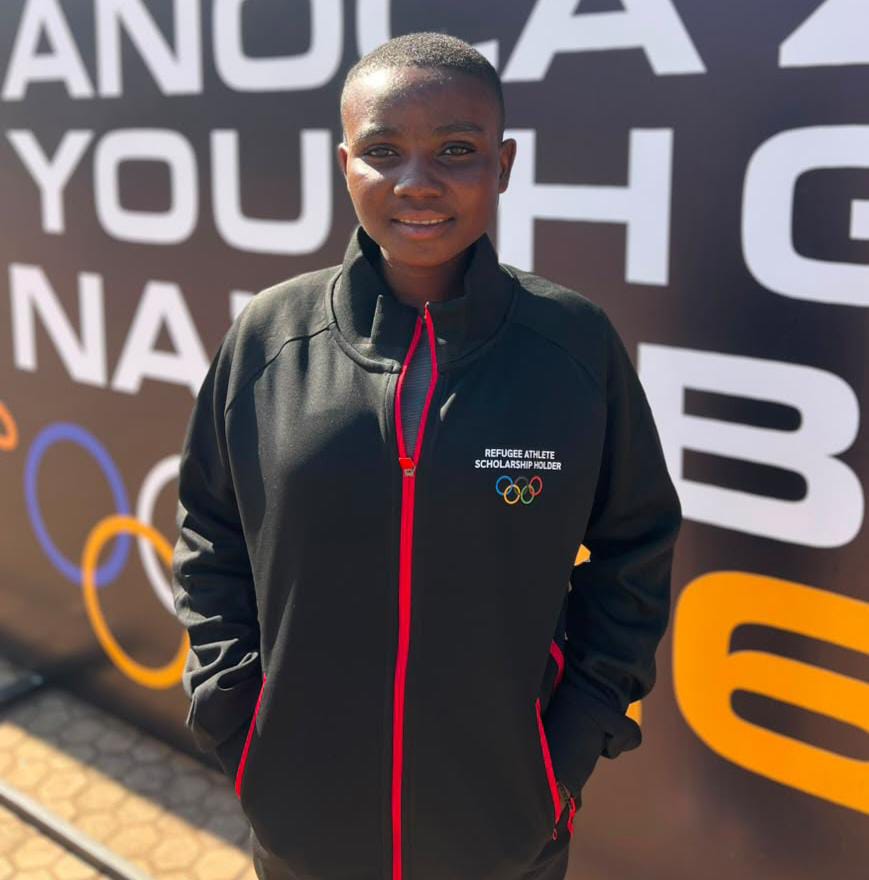
From refugee communities in Uganda to the starting line at Dakar 2026, Florence Masembe and Rachid Rochene are turning sport into a pathway for hope, connection and opportunity.
When Florence Masembe and Rachid Rochene step onto the athletics track in Dakar, Senegal, they will not be running only for themselves. They will carry the dreams of young people they have met on playing fields and in communities across Uganda, including young refugees who have grown up surrounded by uncertainty but continue to imagine a different future.
Florence, 17, and Rachid, 16, will also make history as members of the first Refugee Olympic Team to compete at a Youth Olympic Games.
Both were born in the Democratic Republic of Congo and are now based in Uganda. Both are passionate about athletics and members of Game Connect, an initiative supported by the Olympic Refuge Foundation that uses sport to support the mental health and psychosocial well-being of young people affected by displacement.
After years of training, local competitions and international preparation, the two athletes are preparing to compete in the women's and men's 200 metres respectively.
Their journey is bigger than a race. It is a story about what can happen when young people are given a safe space to play, opportunities to develop their talents and the confidence to believe that a difficult beginning does not have to determine the ending.
Game Connect operates in Adjumani, Kampala, Kamwenge and Kyangwali, bringing displaced and host-community young people together through sport. The programme provides opportunities to build confidence, strengthen social connections, develop life skills and improve well-being, reaching more than 10,000 young people.
For young people affected by displacement, these opportunities can be especially important. Displacement can disrupt education, friendships, family life and a sense of belonging. A football pitch, athletics track or sports field cannot solve every problem, but it can create a place where a young person feels seen. Sometimes, it can also reveal a talent that might otherwise have remained hidden.
That is what makes the connection between Game Connect and Dakar so powerful. Florence and Rachid were not discovered first on an Olympic stage. Their journey began within a community programme, demonstrating how investment in grassroots sport can create pathways to elite competition.
For Rachid, the road to Dakar has been shaped by life in Masajja, Kampala. At 16, he is already an experienced young competitor, having taken part in four Uganda Athletics Championships at Namboole. His event, the 200m, demands speed, technique, strength, discipline and composure under pressure.
Every competition has taught him something: the excitement of performing well, the disappointment of falling short, the pressure of facing stronger athletes and the discipline required to return to training.
But athletics has offered Rachid more than competition. Through Game Connect, sport has become a place where he can connect with others, develop confidence and support his mental well-being.
In Kamwenge, Florence has been finding her own path. Originally from the Democratic Republic of Congo, she is passionate about athletics, music and dancing. She competes in the 200m and, like Rachid, is part of Game Connect and has competed at the Uganda Athletics Championships in Namboole.
Her story reflects the transformation at the heart of the programme: a young refugee athlete finding confidence and opportunity through sport.
Florence's ambition, however, extends beyond her own performance. She hopes to use sport to change and inspire young people in Kamwenge through her performances. Her journey is therefore not simply about preparing to race, but about thinking about what happens after the race.
Her performance can tell young people in Kamwenge that talent can be developed and that circumstances do not have to determine ambition. Sometimes, a young person needs to see someone like themselves succeed before they can imagine themselves succeeding.
## Two Athletes, One Bigger Challenge
Florence and Rachid will race in different fields, but they share the same challenge: running 200 metres as fast as possible.
Their Olympic journey, however, is also a challenge to much larger limitations. They are challenging assumptions about refugees, demonstrating that elite sporting potential can emerge outside established sporting systems and showing that displacement does not have to define a young person's future.
Their selection became significant when the International Olympic Committee announced the first-ever Refugee Olympic Team for the Youth Olympic Games. The team provides a platform to elevate young refugee athletes and highlight the experiences and potential of young people affected by displacement.
Florence and Rachid therefore arrive in Dakar carrying a story that extends beyond the athletics track. They are part of a generation of young Africans growing up in communities shaped by displacement, but also part of a generation showing what becomes possible when those communities are given opportunities.
## From Community Fields to Kaptagat
The journey from Game Connect to Dakar did not happen overnight.
After being identified through the programme, Florence and Rachid became part of a more structured preparation process. They trained at the Complete Sports Facility in Kaptagat, Kenya, where sessions included stability, core strength and wider athletic development.
The training camp also brought the six athletes selected for Dakar together. Normally spread across Kenya and Uganda, they had an opportunity to train as a group, learn from one another and develop a sense of team identity.
For young athletes who usually train in different locations, that companionship was important. Sport once again became a source of connection.
The same principle lies at the heart of Game Connect: sport creates connection; connection creates belonging; belonging can create confidence; and confidence can create opportunity.
## Learning from Champions
The training camp gave Florence and Rachid an opportunity to meet Eliud Kipchoge, the Kenyan Olympic champion and global distance-running icon who served as the Official Refugee Team Mentor.
Kipchoge spoke to the athletes about teamwork, discipline, performance and making the most of their opportunity.
For young athletes preparing for their first Youth Olympic Games, such guidance can have an impact beyond a single competition. Elite sport is not only about physical ability. It requires discipline, patience and resilience after failure. It requires athletes to listen, learn and return to training.
These are also life skills. A young person who learns how to work toward a goal on a track can apply that discipline to school, work or another ambition. Someone who learns to cooperate with teammates can build stronger relationships in the community. And someone who experiences both victory and defeat can develop resilience.
The athletes have also been guided by Yiech Pur Biel, their Chef de Mission and a member of the first Refugee Olympic Team at Rio 2016. His experience gives the young athletes valuable perspective on what it means to compete under the Refugee Olympic Team identity and represent people who may never have the opportunity to stand on an Olympic stage.
Before Dakar, the Game Connect Refugee Team travelled to Nairobi for the ANOCA Zone V Games. Emmanuel Talipany competed in the 100m, while Florence and Rachid competed in the 200m.
For both athletes, the competition provided valuable international exposure and preparation. It introduced new environments, competitors and expectations while teaching them how to manage the emotions that come with representing something larger than themselves.
Nairobi was another step toward Dakar, where the spotlight would be brighter and the significance greater.
For Florence and Rachid, success will not be measured only by where they finish. Their presence can inspire another young athlete to join a community programme. It can encourage a refugee young person to believe that displacement does not erase talent. And it can encourage communities to see refugees not simply through the lens of need, but also through the lens of potential.
Game Connect uses sport to create safe spaces, connection, confidence and well-being. The Refugee Olympic Team creates a global platform for athletes affected by displacement. This is where the mission of Game Connect connects directly with the mission of the Refugee Olympic Team.
When Florence and Rachid step into the starting blocks in Dakar, the race will last only a few seconds. But they will also represent something for the young people watching from Kamwenge, Kampala and refugee communities across Uganda.
For Florence and Rachid, Dakar is not the end of the journey. It is a reminder that where you begin does not have to determine where you finish.
From Game Connect to Dakar: Florence and Rachid Carry the Dreams of a Generation of Refugees